Unconventional
Vintage/old school
Notesbavarian iris germanica butterbergamotcassisjasminejasmine sambacorange blossomorris (iris root)patchoulipink peppertuberosetuberose absolute
Tags
#clean
#savory
Style
unisex
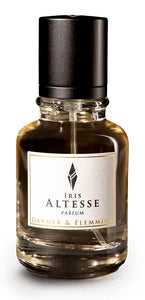
Named after a rare, indigenous white grape variety from Savoy, this cool, modern iris interpretation is built on the brand’s highest-dosed and rare Bavarian iris pallida. Based on standard iris concentrations of around 0.1% in the fragrance oil, Iris Altesse contains an approximately 26-fold higher dose of iris butter and iris extract. Here, iris root revels in its chalky, clean leather side, with a fruity flourish supplied by jasmine sambac and cassis. Classy and hip.
Perfumer: Antoine Lie
All about this fragrance
Vibe check
Think of a sharply cut jacket worn without ceremony: composed at first, less conventional up close. The chalky iris and clean leather facets suggest a reserved presence, while cassis and white flowers bring an unexpected brightness as conversation draws nearer.
How to wear
Start with one or two sprays on skin and let the extrait settle before adding more. Mild spring or autumn weather is a natural setting for its cool iris texture; in warmer conditions, keep application light so the white flowers and fruity accents do not crowd its chalky character.
Who it’s for
For iris lovers who prefer rooty, chalky and leather-like textures to sugary powder. Its savory edge and old-school floral poise will appeal to those drawn to unconventional compositions, while jasmine and cassis offer a brighter counterpoint.
Release year
2025
The nose
Antoine Lie is known for compositions that explore unusual textures and bold contrasts, from the leathery intensity of Rien to the provocative Sécrétions Magnifiques for Etat Libre d’Orange. For Iris Altesse, he interprets Bavarian Iris pallida butter and extract through a chalky, clean leather character, offset by white flowers and fruity accents.
Collaborators
Christian Danner developed the Bavarian iris cultivation that supplies the collection, while biologist Marcel Flemming worked on processing the harvested material and developing the perfumes. Their raw-material work underpins Antoine Lie’s composition. Atelier Français des Matières near Lake Geneva contributed finishing work and other ingredients.
Danner & Flemming’s story
Danner & Flemming connects iris cultivation, processing and perfumery in a single undertaking. Each variety’s character guides its fragrance rather than a market-led brief, while harvest-based millésime production makes agricultural variation part of the house’s identity.
Iris Altesse’s concept
Iris Altesse grew from a project exploring the cultivation and processing of fragrant iris in Bavaria, later interpreted by Antoine Lie in Paris. It showcases Bavarian Iris pallida in a cool, modern composition. Its name refers to Altesse, a rare white grape variety from Savoy, connecting the perfume’s fruity lift with fresh, aromatic wines.
Extra info
Iris Altesse contains 2.6% iris materials in the perfume oil—not in the finished bottled liquid. Its signature presentation includes a piece of iris rhizome and a vial of pure iris essence, allowing the raw material to be explored alongside the perfume. The iris is grown and processed in Germany; the finished fragrance is made in France.
Notesbavarian iris germanica butterbergamotcassisjasminejasmine sambacorange blossomorris (iris root)patchoulipink peppertuberosetuberose absolute
Tags
#clean
#savory
Style
unisex
Named after a rare, indigenous white grape variety from Savoy, this cool, modern iris interpretation is built on the brand’s highest-dosed and rare Bavarian iris pallida. Based on standard iris concentrations of around 0.1% in the fragrance oil, Iris Altesse contains an approximately 26-fold higher dose of iris butter and iris extract. Here, iris root revels in its chalky, clean leather side, with a fruity flourish supplied by jasmine sambac and cassis. Classy and hip.
Perfumer: Antoine Lie
All about this fragrance
Vibe check
Think of a sharply cut jacket worn without ceremony: composed at first, less conventional up close. The chalky iris and clean leather facets suggest a reserved presence, while cassis and white flowers bring an unexpected brightness as conversation draws nearer.
How to wear
Start with one or two sprays on skin and let the extrait settle before adding more. Mild spring or autumn weather is a natural setting for its cool iris texture; in warmer conditions, keep application light so the white flowers and fruity accents do not crowd its chalky character.
Who it’s for
For iris lovers who prefer rooty, chalky and leather-like textures to sugary powder. Its savory edge and old-school floral poise will appeal to those drawn to unconventional compositions, while jasmine and cassis offer a brighter counterpoint.
Release year
2025
The nose
Antoine Lie is known for compositions that explore unusual textures and bold contrasts, from the leathery intensity of Rien to the provocative Sécrétions Magnifiques for Etat Libre d’Orange. For Iris Altesse, he interprets Bavarian Iris pallida butter and extract through a chalky, clean leather character, offset by white flowers and fruity accents.
Collaborators
Christian Danner developed the Bavarian iris cultivation that supplies the collection, while biologist Marcel Flemming worked on processing the harvested material and developing the perfumes. Their raw-material work underpins Antoine Lie’s composition. Atelier Français des Matières near Lake Geneva contributed finishing work and other ingredients.
Danner & Flemming’s story
Danner & Flemming connects iris cultivation, processing and perfumery in a single undertaking. Each variety’s character guides its fragrance rather than a market-led brief, while harvest-based millésime production makes agricultural variation part of the house’s identity.
Iris Altesse’s concept
Iris Altesse grew from a project exploring the cultivation and processing of fragrant iris in Bavaria, later interpreted by Antoine Lie in Paris. It showcases Bavarian Iris pallida in a cool, modern composition. Its name refers to Altesse, a rare white grape variety from Savoy, connecting the perfume’s fruity lift with fresh, aromatic wines.
Extra info
Iris Altesse contains 2.6% iris materials in the perfume oil—not in the finished bottled liquid. Its signature presentation includes a piece of iris rhizome and a vial of pure iris essence, allowing the raw material to be explored alongside the perfume. The iris is grown and processed in Germany; the finished fragrance is made in France.