Aromatic
Green
Unconventional
Notesblack peppercedarwoodcinnamonclovesfrankincensegeraniumgingerleathermyrrhsylphium accordtobacco
Tags
#fresh
#smoky
Style
unisex
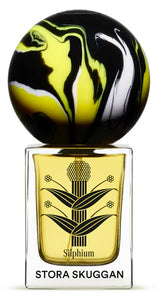
Silphium was a plant widely renowned as a spice, medicinal herb and perfume ingredient throughout the empires of classical antiquity, outshining both saffron and cinnamon. It was praised by Greek philosophers and writers, as well as Roman emperors and cookbook authors. The demand for Silphium eventually became so overwhelming that it was harvested to extinction, and the taste and smell of the once greatest spice in the world were lost in time.
This extinct plant was reconstructed by researching assumed relatives of Silphium, using aromachemicals (the molecular building blocks of scents) to create an accord reflecting historical descriptions. This is set against a background of ancient incense, woods and leather.
All about this fragrance
Vibe check
For a late afternoon spent browsing a secondhand bookshop, with a wool coat over one arm. The green, peppery opening brings an alert edge; tobacco, incense and leather give the fragrance a quieter, contemplative register as the surroundings grow still.
How to wear
Try it in mild to cool weather, when the contrast between green freshness and smoky resins can feel especially distinct. Start with one or two sprays on skin beneath clothing for a more contained impression; an exposed wrist lets the peppery, aromatic facets meet the air. Apply lightly in warmer conditions.
Who it’s for
For those drawn to aromatic greens, dry spices and incense rather than sweetness. Its unusual herbal accord will appeal to curious wearers who enjoy tobacco, resin and leather compositions with a fresh edge and a conceptual story.
Release year
2017
The nose
Tomas Hempel and Olle Hemmendorff co-created Silphium for Stora Skuggan. Their approach combines botanical research with imaginative reconstruction: an aromachemical accord evokes the vanished herb, while spices, incense, woods and leather build its surrounding world.
Stora Skuggan’s story
Stora Skuggan is a Stockholm fragrance collective that brings composition, production, artwork and packaging together in its own studio. Myths and scientific phenomena provide starting points for experimentation, with natural and synthetic materials chosen for their contribution to the scent rather than an all-natural ideal.
Silphium’s concept
Silphium takes its name from the prized botanical material of classical antiquity, associated with Cyrene in present-day Libya. Working from historical descriptions and plants thought to be its surviving relatives, the perfumers imagined its aroma rather than claiming an authenticated reproduction. Incense, spices and leather evoke Hempel’s vision of an ancient marketplace.
Extra info
Silphium was Stora Skuggan’s second fragrance and an Artisan-category finalist at the 2018 Art and Olfaction Awards. A depiction of the plant appears on the bottle, carrying the lost-botanical theme into its design.
Also featured in
Festive Scents
Notesblack peppercedarwoodcinnamonclovesfrankincensegeraniumgingerleathermyrrhsylphium accordtobacco
Tags
#fresh
#smoky
Style
unisex
Silphium was a plant widely renowned as a spice, medicinal herb and perfume ingredient throughout the empires of classical antiquity, outshining both saffron and cinnamon. It was praised by Greek philosophers and writers, as well as Roman emperors and cookbook authors. The demand for Silphium eventually became so overwhelming that it was harvested to extinction, and the taste and smell of the once greatest spice in the world were lost in time.
This extinct plant was reconstructed by researching assumed relatives of Silphium, using aromachemicals (the molecular building blocks of scents) to create an accord reflecting historical descriptions. This is set against a background of ancient incense, woods and leather.
All about this fragrance
Vibe check
For a late afternoon spent browsing a secondhand bookshop, with a wool coat over one arm. The green, peppery opening brings an alert edge; tobacco, incense and leather give the fragrance a quieter, contemplative register as the surroundings grow still.
How to wear
Try it in mild to cool weather, when the contrast between green freshness and smoky resins can feel especially distinct. Start with one or two sprays on skin beneath clothing for a more contained impression; an exposed wrist lets the peppery, aromatic facets meet the air. Apply lightly in warmer conditions.
Who it’s for
For those drawn to aromatic greens, dry spices and incense rather than sweetness. Its unusual herbal accord will appeal to curious wearers who enjoy tobacco, resin and leather compositions with a fresh edge and a conceptual story.
Release year
2017
The nose
Tomas Hempel and Olle Hemmendorff co-created Silphium for Stora Skuggan. Their approach combines botanical research with imaginative reconstruction: an aromachemical accord evokes the vanished herb, while spices, incense, woods and leather build its surrounding world.
Stora Skuggan’s story
Stora Skuggan is a Stockholm fragrance collective that brings composition, production, artwork and packaging together in its own studio. Myths and scientific phenomena provide starting points for experimentation, with natural and synthetic materials chosen for their contribution to the scent rather than an all-natural ideal.
Silphium’s concept
Silphium takes its name from the prized botanical material of classical antiquity, associated with Cyrene in present-day Libya. Working from historical descriptions and plants thought to be its surviving relatives, the perfumers imagined its aroma rather than claiming an authenticated reproduction. Incense, spices and leather evoke Hempel’s vision of an ancient marketplace.
Extra info
Silphium was Stora Skuggan’s second fragrance and an Artisan-category finalist at the 2018 Art and Olfaction Awards. A depiction of the plant appears on the bottle, carrying the lost-botanical theme into its design.
Also featured in
Festive Scents